Download the GoTyme Bank app
Switch to a beautiful banking experience today.
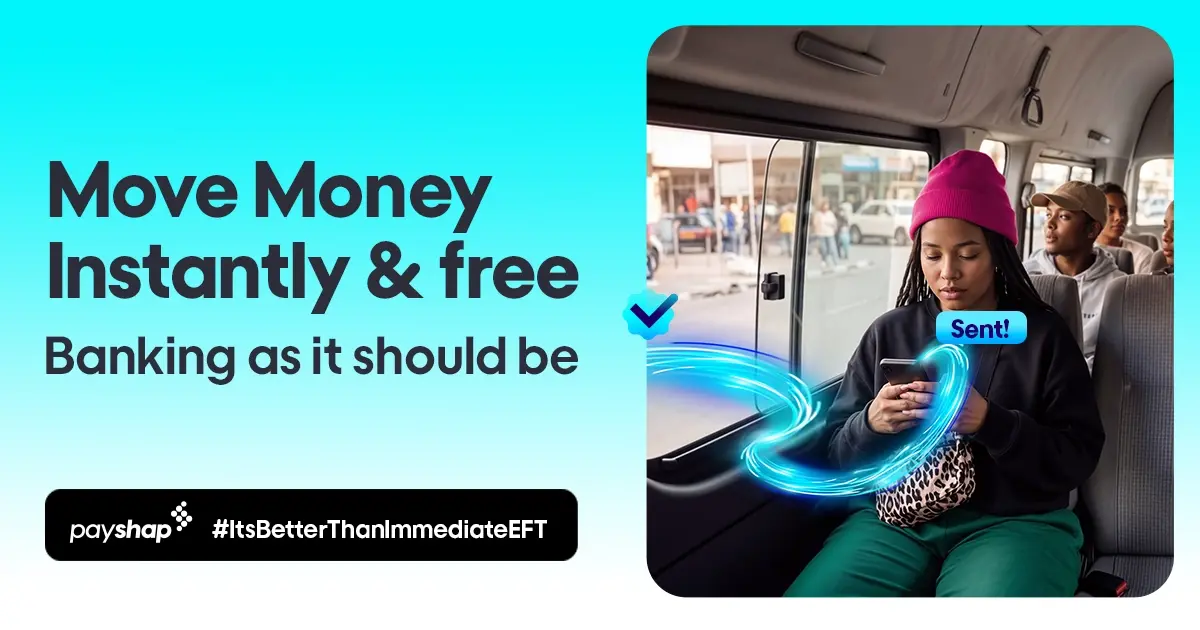
For decades, we've accepted a strange reality in banking. You can send a message across the world for free. You can stream a movie instantly. You can order food, hail a ride or join a video call in seconds. Yet when it comes to sending money, we're often still faced with delays, cut-off times, and transaction fees.
South Africa took a major step toward solving this problem with the launch of PayShap in 2023. A real-time payment system designed to make account-to-account transfers instant, available 24/7, and as simple as sending money to a cellphone number, PayShap has proven that a better way to pay was possible. Yet three years later, one challenge remains: while instant payments are possible, they are still not free or accessible by default. Some banks continue to treat instant payments as a premium service. And that distinction matters.
Today, South African banks have adopted noticeably different approaches to PayShap pricing, resulting in a fragmented experience for consumers. Here's how the major banks have priced PayShap:
| Bank | Up to R100 | R100 - R1,000 | R1,000 - R3,000 | R3,000 - R5,000 |
| GoTyme Bank | Free | Free | Free | Free |
| Absa | Free | Up to R7.50 | R7.50 | n/a |
| African Bank | Free | Up to R3.50 | R3.50 | n/a |
| Capitec | R1 - R2 | R1 - R2 | R1 - R2 | n/a |
| Discovery Bank | R1 | R5 | 0.5% of transaction – up to R35 | 0.5% of transaction – up to R35 |
| FNB | R3 - R5 | R3 - R5 | R3 - R5 | n/a |
| Investec | Free | Up to R6 | R6 | R6 |
| Nedbank | Free | Free to cell number R10 to account number |
Free to cell number R10 to account number |
Free to cell number R10 to account number |
| Standard Bank | R2 | R2 | R2 | n/a |
Pricing reflects publicly available PayShap fees as at 30 June 2026
These comparisons highlight a growing divide in South African banking. On one side are banks that continue to position instant payments as a chargeable service, reflecting the view that moving money is something customers should pay for. On the other side are banks that increasingly see payments as a utility, something that should simply work, instantly, at little or no additional cost.
Given that at least one bank has demonstrated that free instant payments can work at scale, the conversation is starting to shift. The question is no longer whether free instant payments are possible, but why payments are still being treated as a revenue stream rather than core infrastructure.
The competitive risk for incumbent banks is not that customers will compare one PayShap fee against another. It's that they'll begin questioning the very idea of paying to move money. Once a customer experiences instant payments at no cost, charging R2, R5 or R10 to simply move their money starts to feel less like a service fee and more like a legacy practice.
Every time someone sends money to a friend, pays a domestic worker, settles a shared bill, pays a small business, or sends money to family, the transaction costs accumulate. And for millions of South Africans, these service fees can make a meaningful difference. Even a R2 charge can represent a sizeable percentage of a small-value payment. PayShap was designed to change that equation.
PayShap wasn't created simply to make payments faster. It was designed to modernise South Africa's payment ecosystem, reduce reliance on cash, promote financial inclusion and drive digital adoption. Yet industry leaders themselves have acknowledged that fragmented pricing models are slowing adoption and undermining those objectives. The uncomfortable truth is that the technology challenge has largely been solved. The real question now is whether banks are willing to stop charging for something customers increasingly expect to be free.
Do you celebrate when an email arrives instantly? Or congratulate a streaming platform for delivering a video without buffering? Probably not. That is because the most successful technologies eventually fade into the background. They become so seamless and reliable that we stop noticing them altogether. We simply expect them to work.
Payments should be no different.
The big opportunity is to make instant payments so affordable that they become the default way South Africans exchange value. That is how countries such as Brazil transformed their payment landscape through Pix. It is how India accelerated digital payment adoption through UPI.
The hope is that, in five years' time, consumers won't be asking whether to make a payment via PayShap, an EFT, or something else entirely. They will simply expect money to move instantly, and at no cost.
The banks that embrace that future will help shape it. Those that continue treating instant payments as a premium feature, meanwhile, may find themselves defending a business model that customers no longer see value in.